Hazardous Waste Disposal Edinburgh

Hazardous waste disposal for Edinburgh businesses, laboratories and schools under Scotland's special waste rules, with SEPA-coded consignment notes and the right timing if waste is going to a facility outside Scotland.

HomeHazardous Waste Disposal Edinburgh

Hazardous Waste Disposal Edinburgh quote

Special waste in Edinburgh

Hazardous waste disposal in Edinburgh covers unwanted chemicals, solvents, oils, contaminated materials and other waste from commercial premises, laboratories, schools and research facilities. In Scotland, waste with hazardous properties is called special waste. It is controlled by the Special Waste Regulations 1996, as amended for Scotland, and regulated by SEPA rather than the Environment Agency.

For a collection, the important details are what the waste contains, how much there is, the condition of the containers and where they are stored. Original labels, chemical names and any available safety data sheets help establish what is being collected. Unidentified materials need further assessment before a suitable disposal arrangement can be determined.

The City of Edinburgh Council’s household waste services are for residents. Businesses and other organisations producing special waste have separate responsibilities for its classification, transfer and disposal at appropriately authorised facilities.
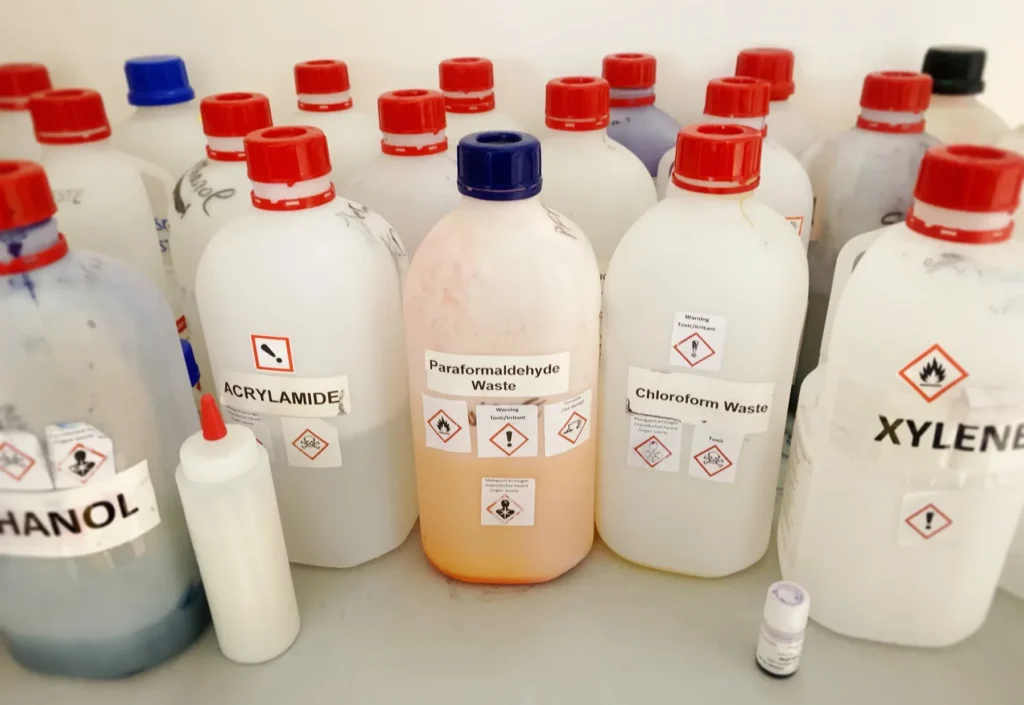

Plastic laboratory bottles with red and blue caps, hand-labelled as chloroform, paraformaldehyde and acrylamide waste, with hazard pictograms on the labels

SEPA-coded notes

Special waste consignments require a unique SEPA-issued code, whether the destination is in Scotland or elsewhere in the UK.

Cross-border timing

Pre-notification requirements depend on the destination, with exemptions applying to certain movements.

Laboratory and school chemicals

Chemical names, quantities, container conditions and available hazard information help establish collection and disposal requirements.

How the Scottish rules differ from England

Businesses with premises in both Scotland and England need to account for differences in special waste documentation. Scottish consignments use the following arrangements:

  • Every special waste consignment note carries a unique code issued by SEPA, whatever the destination in the UK.
  • The codes begin SA, SB or SC. SB codes are reserved for consignments consisting entirely of lead acid motor vehicle batteries.
  • There is no producer registration for special waste in Scotland.
  • SEPA provides PDF and Excel consignment-note formats, prefers Excel and requests electronic submission of completed notes.

Our guide to the hazardous waste consignment note explains the documentation used in England. Scottish special waste notes require comparable waste details but use their own format and SEPA-issued codes.

When waste leaves Scotland

Moves between two places in Scotland do not need pre-notification. If special waste is going from Edinburgh to a facility outside Scotland, SEPA normally requires parts A and B of the consignment note to be submitted at least 72 hours and no more than one month before the movement.

There are exemptions for certain movements. Regular consignments of the same type of waste to the same facility may only require pre-notification of the first movement in a year, provided the relevant conditions are met and subsequent notes refer to the initial notification. The destination therefore matters when arranging collection, particularly if the waste is being sent to a facility in England or elsewhere in the UK.

Laboratories, schools and research stock

Edinburgh laboratories, universities, hospitals and school science departments may have unwanted reagents, part-used chemical bottles, expired stock, solvents and samples with damaged or missing labels. These materials can require different handling and disposal arrangements according to their composition and hazardous properties.

A useful waste inventory includes the product name, approximate quantity, container size and any known hazards. Acids, solvents, oxidising agents and other potentially incompatible chemicals should be identified separately rather than treated as one mixed load. Unlabelled bottles may need additional investigation.

See laboratory waste disposal for chemical stock and reagents, or our guidance for schools, colleges and universities dealing with unwanted teaching and research chemicals.

A person in orange overalls filling in a hazardous materials checklist on a clipboard beside a road tanker

Special waste to clear in Edinburgh?

Send us a list of what needs to go, where it is stored and how it is packed, and we will come back to you.

Older buildings and city-centre access

Many Edinburgh premises occupy older buildings with shared stairs, basements, restricted loading areas and narrow street frontages. These details can affect how containers are moved from storage to a collection vehicle.

When describing the waste, include the floor where it is stored, whether there is lift access, any steps or narrow passages and where a vehicle can stop. Mention whether containers are in a locked store, laboratory cupboard, external compound or another location. These details help establish the collection requirements before arrangements are agreed.

Scottish Water and trade effluent

Scottish Water is the sewerage authority across Scotland. Discharging trade effluent into its sewers requires consent under section 24 of the Sewerage (Scotland) Act 1968. A laboratory sink is therefore not an alternative way to dispose of spent chemicals unless the discharge is covered by an appropriate consent.

Waste chemicals held in bottles, drums or other containers need to be considered according to their composition, classification and suitable waste management options.

Records and classification

The consignor keeps copies of special waste consignment notes for three years. Waste classification follows the WM3 technical guidance used across the UK, updated by SEPA in partnership with the other UK environment agencies. Classification establishes whether a material is special waste and which controls apply to its movement.

For an Edinburgh collection, provide a description of the waste, quantities, packaging and access conditions. Where chemical identities are uncertain, explain what information is available rather than guessing at the contents.

For premises in the west of Scotland, see hazardous waste disposal in Glasgow, or view all areas we cover.

Hazardous Waste Disposal Edinburgh: common questions

Is special waste the same as hazardous waste?

Broadly, yes. Special waste is the term used in Scotland for waste with hazardous properties, and it is regulated by SEPA under the Special Waste Regulations 1996 as amended for Scotland. England uses the term hazardous waste under its own regulations, with different consignment notes and codes.

Do we need to tell SEPA before special waste leaves our Edinburgh premises?

Not if the waste is moving between two locations in Scotland. If it is going outside Scotland, or coming into Scotland from elsewhere, pre-notification is normally required at least 72 hours and no more than one month before the movement. Exemptions apply to certain movements, including qualifying repeat consignments. A consignment note is still required.

Does our school need to register as a special waste producer?

No. There is no producer registration for special waste in Scotland. Each consignment does need a consignment note with a unique code from SEPA, and the school, as consignor, keeps copies of its notes for three years.

We have special waste in Edinburgh and hazardous waste at a site in England. Can we use one set of paperwork?

No. Waste produced in Scotland is consigned on a special waste consignment note with a SEPA code. Waste produced in England uses the English hazardous waste consignment note and its own rules. Each site follows the paperwork for the country where the waste is produced.

What items are classed as special waste in Edinburgh?

Waste with hazardous properties, such as many laboratory chemicals, solvents, acids, oils, pesticides, batteries and contaminated packaging. Whether a particular waste qualifies is decided by classification under the WM3 guidance, which applies in Scotland as in the rest of the UK, using its composition and hazardous properties.

Chemical Waste Disposal

Services

Request a quote

Menu

Get a quote